Blue and Gold Macaw Training and Talking Ability
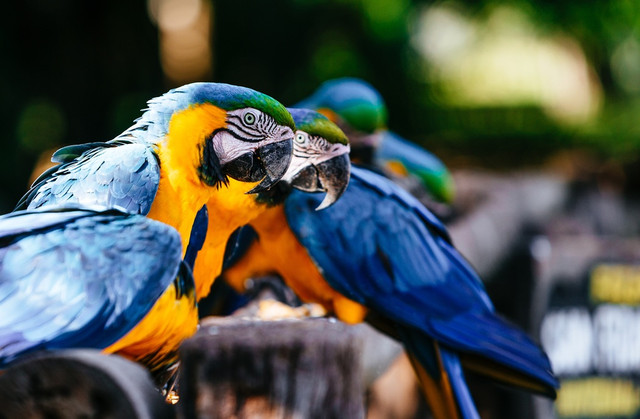
One of the most common questions from prospective owners is whether a blue and gold macaw parrot can talk, and how easy the species is to train. The answer is encouraging for anyone drawn to an interactive, communicative companion bird, though success depends heavily on consistent, patient training.


Can Blue and Gold Macaws Talk?
Yes, blue and gold macaws are capable talkers, though they are generally not as naturally gifted with speech as smaller species like African greys or budgerigars. Most macaws that are exposed to consistent verbal interaction from a young age can learn a vocabulary ranging from a handful of words to several dozen phrases. Clarity varies from bird to bird; some develop remarkably clear speech, while others favor a wider repertoire of whistles, sound effects, and household noises like phone rings or laughter over formal words.
Individual personality plays a large role. Some macaws are naturally more vocal mimics, while others express themselves more through body language and screaming than through learned speech. Owners hoping for a talkative bird should choose a young, hand-raised macaw and begin consistent verbal interaction early, though there is no guarantee of how much any individual bird will eventually say.
Trainability
Blue and gold macaws for sale are highly intelligent, often compared to a young child in terms of problem-solving ability, which makes them excellent candidates for training. They respond well to positive reinforcement methods, learning tricks such as waving, turning around, retrieving objects, and stepping up on command relatively quickly when training is consistent and rewarding.
Their intelligence is a double-edged sword, however. A bored or under-trained macaw can just as easily learn undesirable habits, such as screaming for attention or biting to get a reaction, so early and ongoing training is important for shaping good behavior over the bird's long lifespan.
Basic Training Tips
Successful training relies on a few core principles. Sessions should be short, ideally five to fifteen minutes, and held once or twice daily to keep the bird engaged without causing fatigue or frustration. Positive reinforcement, using a favored treat or verbal praise immediately after the desired behavior, builds trust and encourages repetition far more effectively than punishment, which can damage the bond between bird and owner.
Consistency matters as well. Using the same cues and rewards each time helps the macaw understand what is being asked, and involving all household members in basic commands like "step up" helps the bird generalize the behavior rather than obeying only one person.
Using Target and Clicker Training
Many trainers find target training an especially effective starting point for macaws. This involves teaching the bird to touch its beak to a small stick or target on command, rewarding each successful touch with a treat. Once mastered, targeting can be used to guide the bird onto a scale for weighing, into a carrier, or through more advanced tricks, since it gives the handler a simple way to direct the bird's movement without physical contact. Clicker training, which pairs a distinct click sound with an immediate reward, can further sharpen communication between bird and owner by marking the exact moment a desired behavior occurs, making it easier for the macaw to understand precisely what earned the reward.
Common Training Mistakes
New owners sometimes reinforce unwanted behavior without realizing it. For example, rushing to a screaming macaw to quiet it down can inadvertently teach the bird that screaming gets attention. Similarly, punishing a bite with yelling or physical correction often increases fear and aggression rather than resolving the underlying cause. Recognizing and addressing triggers, such as hormonal periods or overstimulation, tends to produce better long-term results than reactive discipline.
Tricks and Enrichment Training
Beyond basic commands, many owners enjoy teaching their macaws entertaining tricks, from ringing a bell to playing basketball with a small hoop toy. Trick training doubles as valuable mental enrichment, giving the bird a productive outlet for its intelligence and energy. Foraging-based training, where the bird works to access food through a puzzle toy, is particularly effective at reducing boredom-driven behaviors.
With patience and consistency, most blue and gold macaw parrots become responsive, engaging companions capable of both charming vocabulary and impressive trained behaviors, making the investment in training well worth the effort for owners willing to put in the time.
What's Your Reaction?